

What keeps you on the phone
Sound familiar?
Who sprayed what?
The records sit with the supervisor, in a book, in a store in Naivasha, on the day the audit is in Nairobi.
Picked too soon
A picker harvests a block that was sprayed yesterday because nobody told them. The residue is found at the other end.
Wrong product, wrong market
A chemical fine for the local market is not fine for the EU. You find out after it is in the tank.
“Hiyo si kilo zangu”
A farmer disputes the weights on payday, and the delivery note went home in someone’s pocket.
Month-end on the side
The accountant retypes farm work, M-PESA lines and invoices into another system, and eTIMS waits.
How it works
From the block to the books in four steps
1. We set you up
Your own web address and your own database. Ready within one business day.
2. Record on the farm
Plantings, scouting, spray records and harvests. Deliveries weighed at the collection centre. In a browser, on a laptop or a phone.
3. The rules check it
Your agronomist approves every spray. PHI, market and season limits are checked. Anything unsafe is refused, with the reason.
4. Pay and close the books
Farmer payment batches, prepared and approved by two people. Invoices to customers and KRA eTIMS. Bank and M-PESA statements matched.
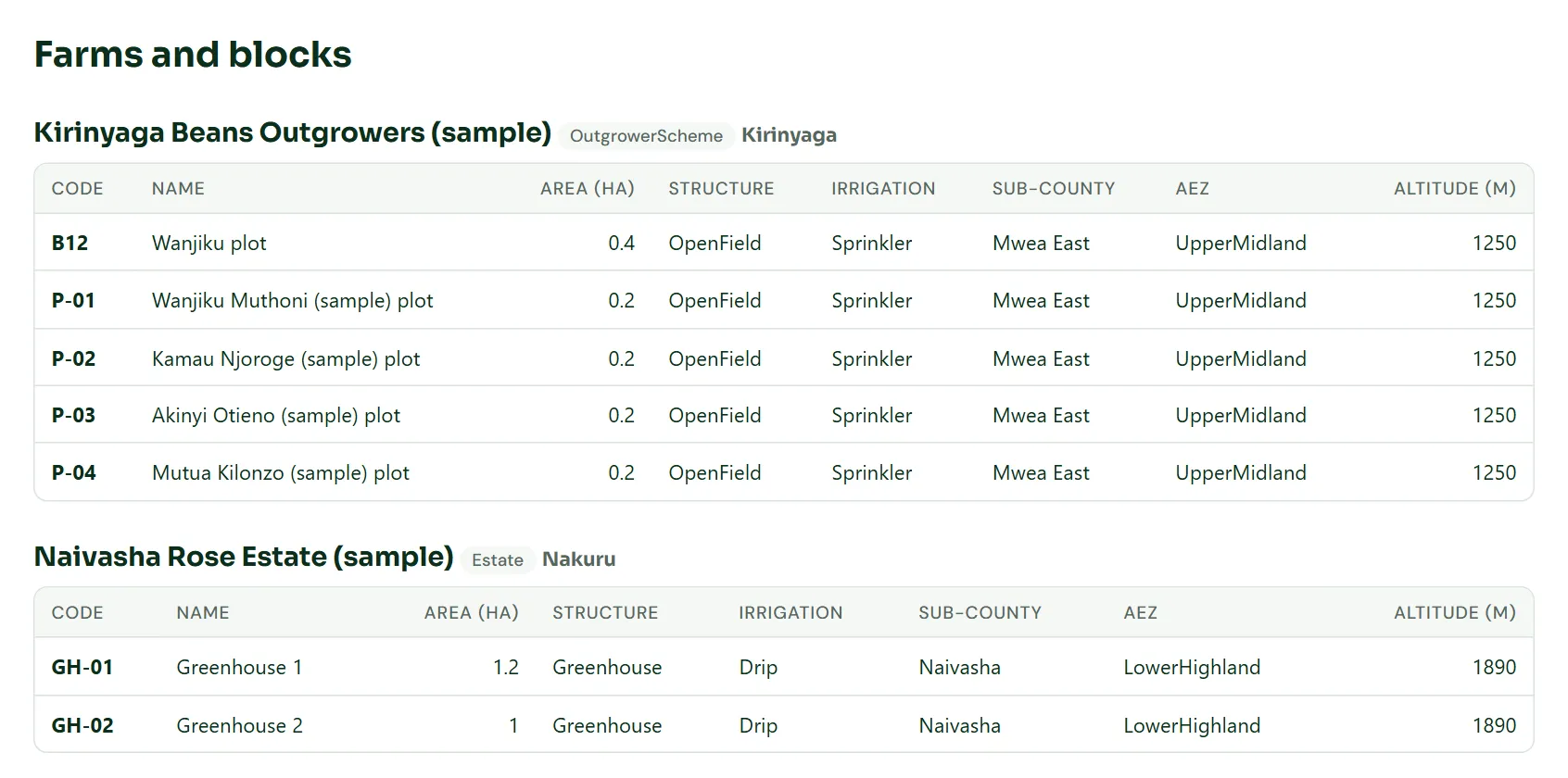
Every block on record, the way Kenyan farms are laid out
Set up each farm and its blocks in hectares or acres, with sub-county, agro-ecological zone, altitude, structure and irrigation.
- A planting on each block: crop, variety, market and expected first harvest
- A Kenyan list of 14 crops and 15 pests to start from
- Estates and outgrower schemes side by side in one workspace
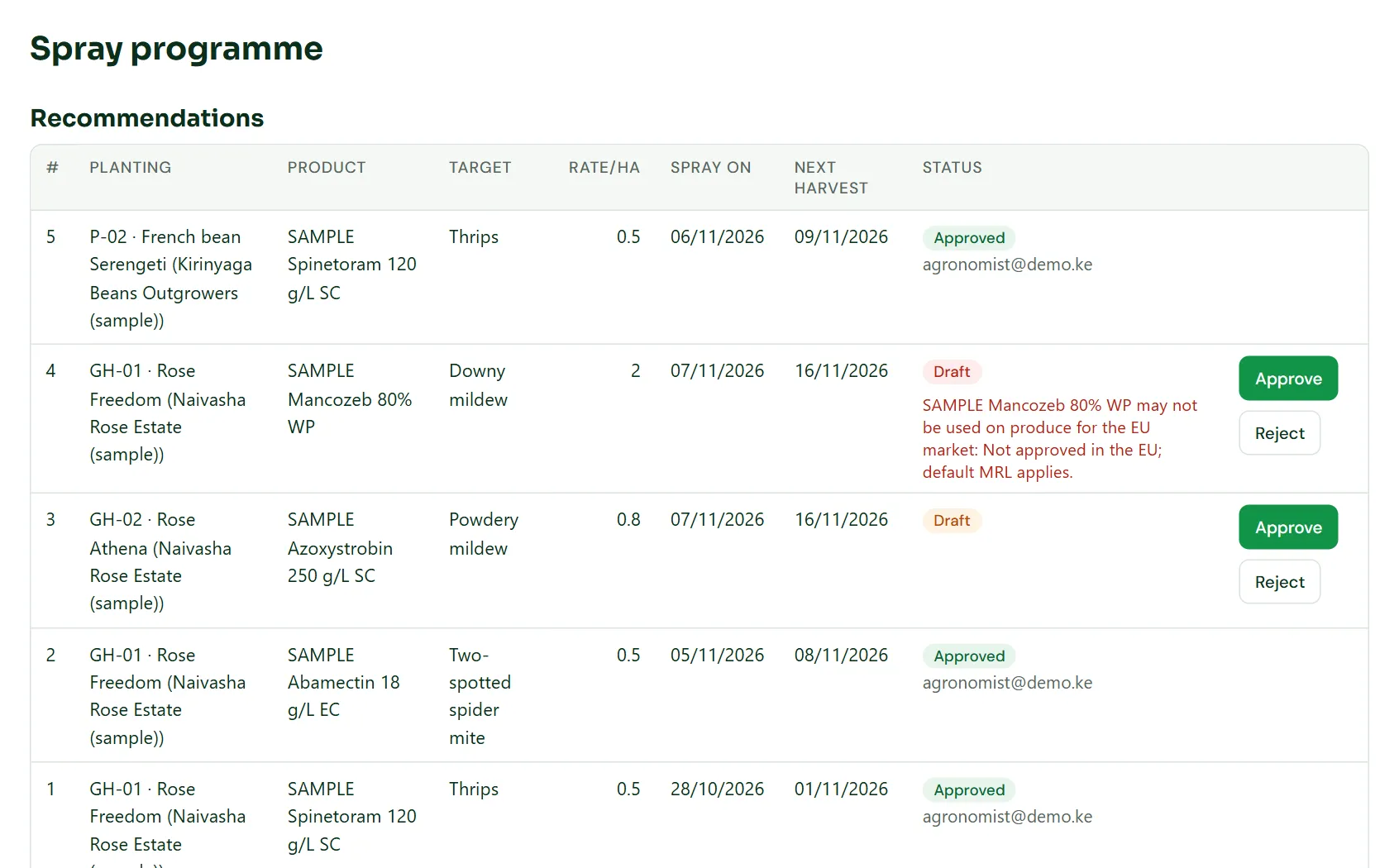
Your agronomist approves every spray, and the rules check it twice
Scouts record what they find. Your bwana shamba recommends. Agriware checks the recommendation when it is written and again when it is approved.
- Scouting by pest, station, count and severity, with threshold breaches on the dashboard
- PCPB registration for the crop and pest
- Destination-market restrictions, so a product barred for the EU stops at the draft
- PHI against the next harvest, applications per season and resistance-group rotation
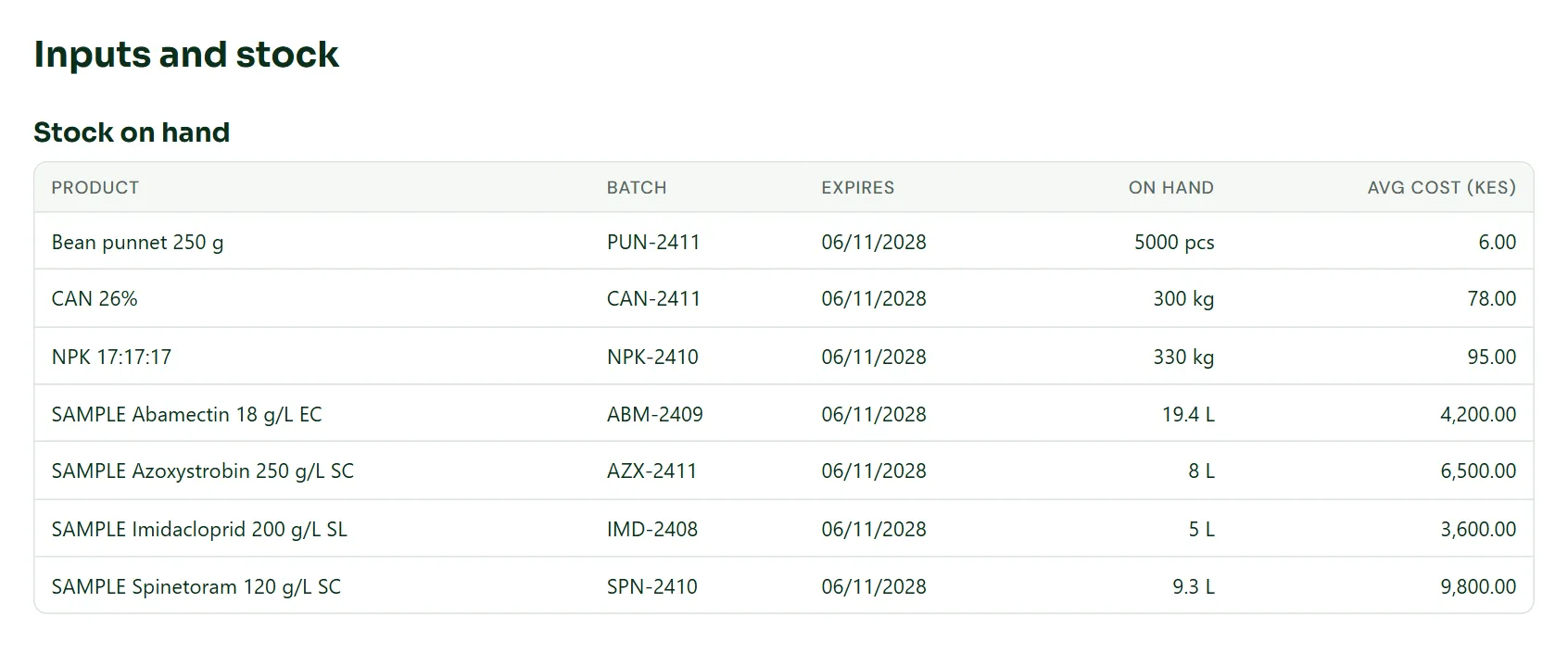
Stock that knows its batch, its cost and its expiry
Receive inputs by batch. Issue them to a planting at weighted-average cost, so each crop carries what it really used.
- Expired, withdrawn and unregistered products are refused
- Chemicals leave the store only through a recorded spray
- Fertiliser, seed and packaging tracked in the same place
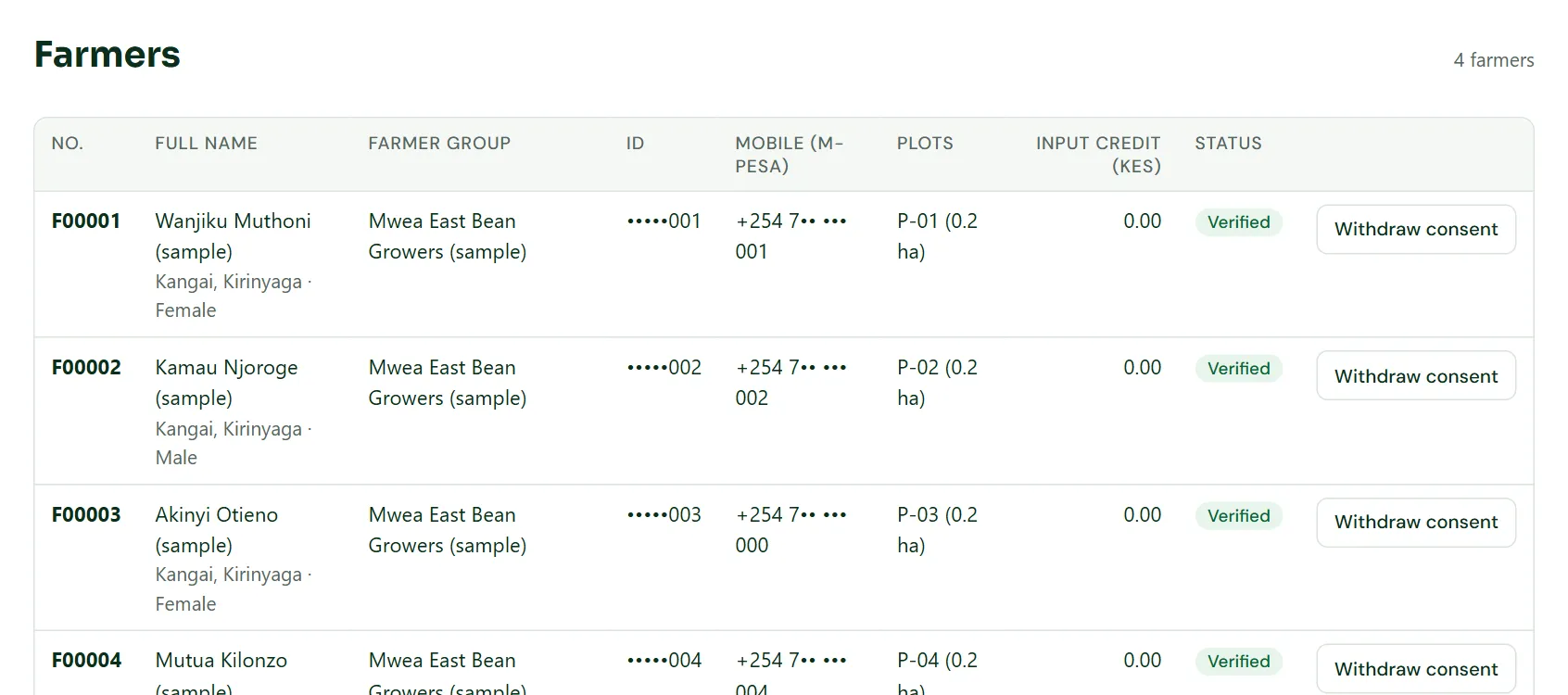
Every mkulima registered, with consent on record
Register farmers, groups and plots with the consent the Data Protection Act expects: which notice, which channel, and when.
- A repeated national ID is refused; the same phone, or the same name in a ward, is flagged
- ID and phone encrypted in the database and masked on screen
- Input credit issued to the farmer and recovered at settlement, capped at 60% of gross
Weights, grades and lot codes at the collection centre
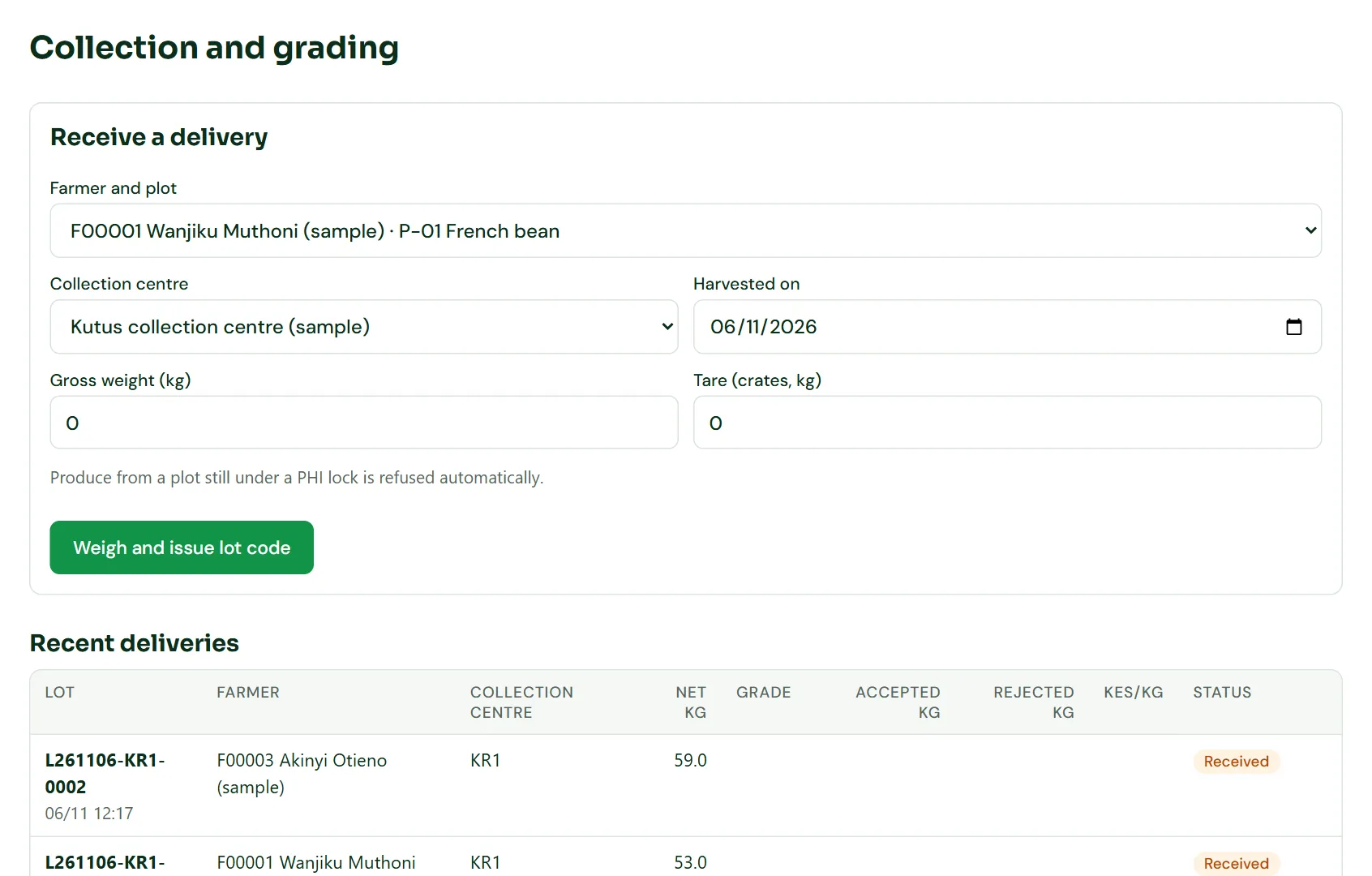
Weigh a delivery and Agriware issues a lot code that ties it to the farmer, plot, date and centre. That ends the argument about whose kilos they were.
- Net weight from gross less the crates
- A plot still under PHI is refused at the scale
- Packhouse QC grades each lot, with rejects and reasons
- The grade price in force on the day goes on the lot
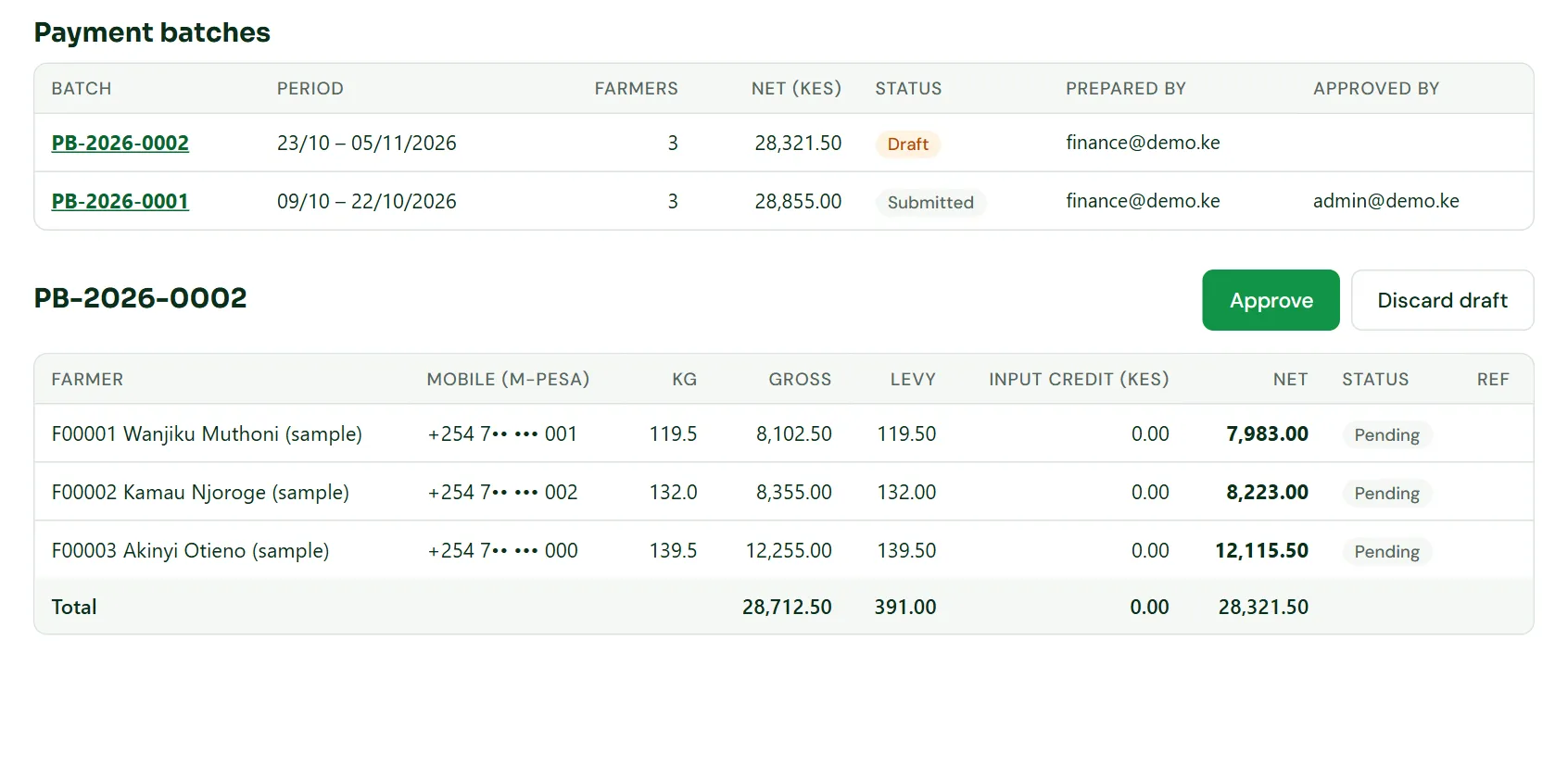
Farmer payments one person prepares and another approves
Build a batch from graded lots. Levies by farmer group and input credit come off automatically. The person who prepared it cannot approve it.
- Paid out by M-PESA, on your own Safaricom contract
- A failed line keeps its reason and stays open for a retry, without paying anyone twice
- Payable, levy and payout journals post to the books
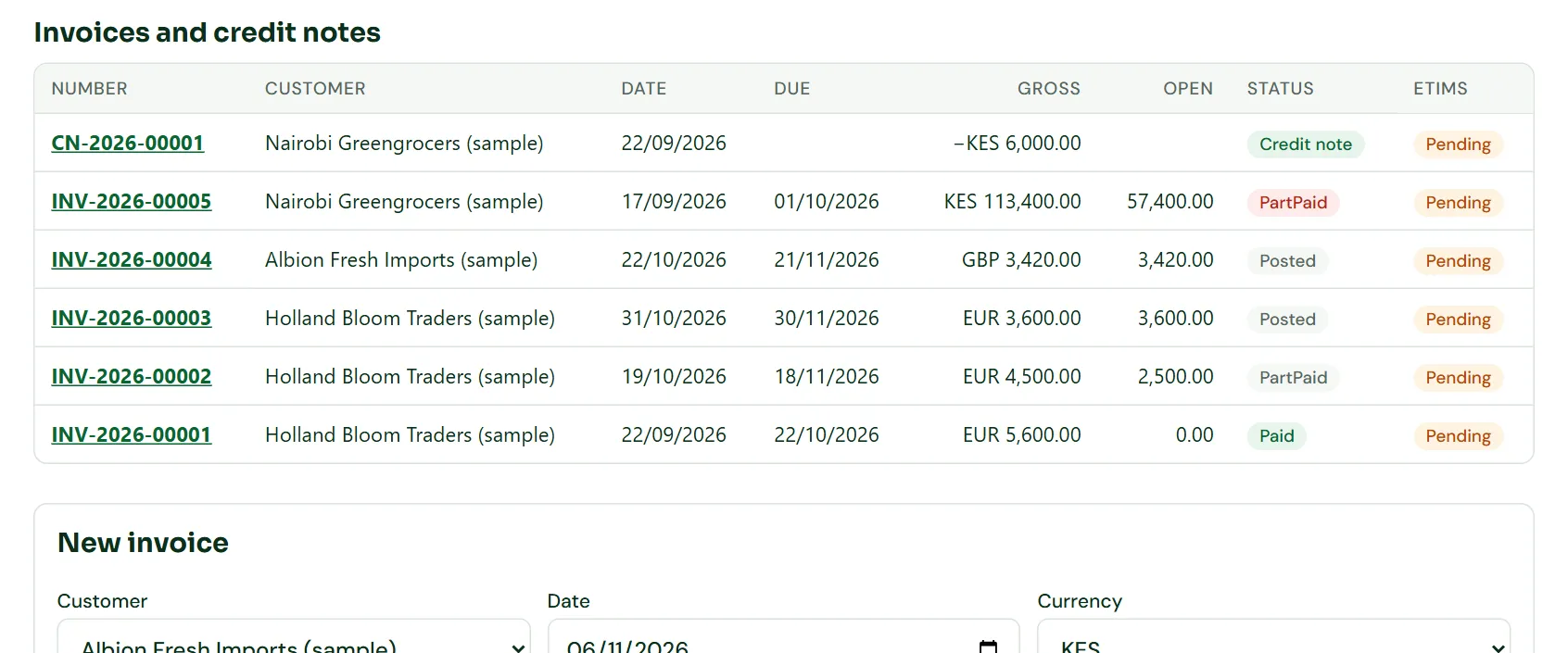
Invoices in euro, pounds and shillings, sent to KRA eTIMS
Invoice local and export customers from one list. Each invoice and credit note goes to KRA through your own eTIMS OSCU device.
- KES, USD, EUR and GBP with dated rates
- VAT categories per line, credit notes and debtor ageing
- If KRA or the network is down, invoices wait in a queue and go when it returns
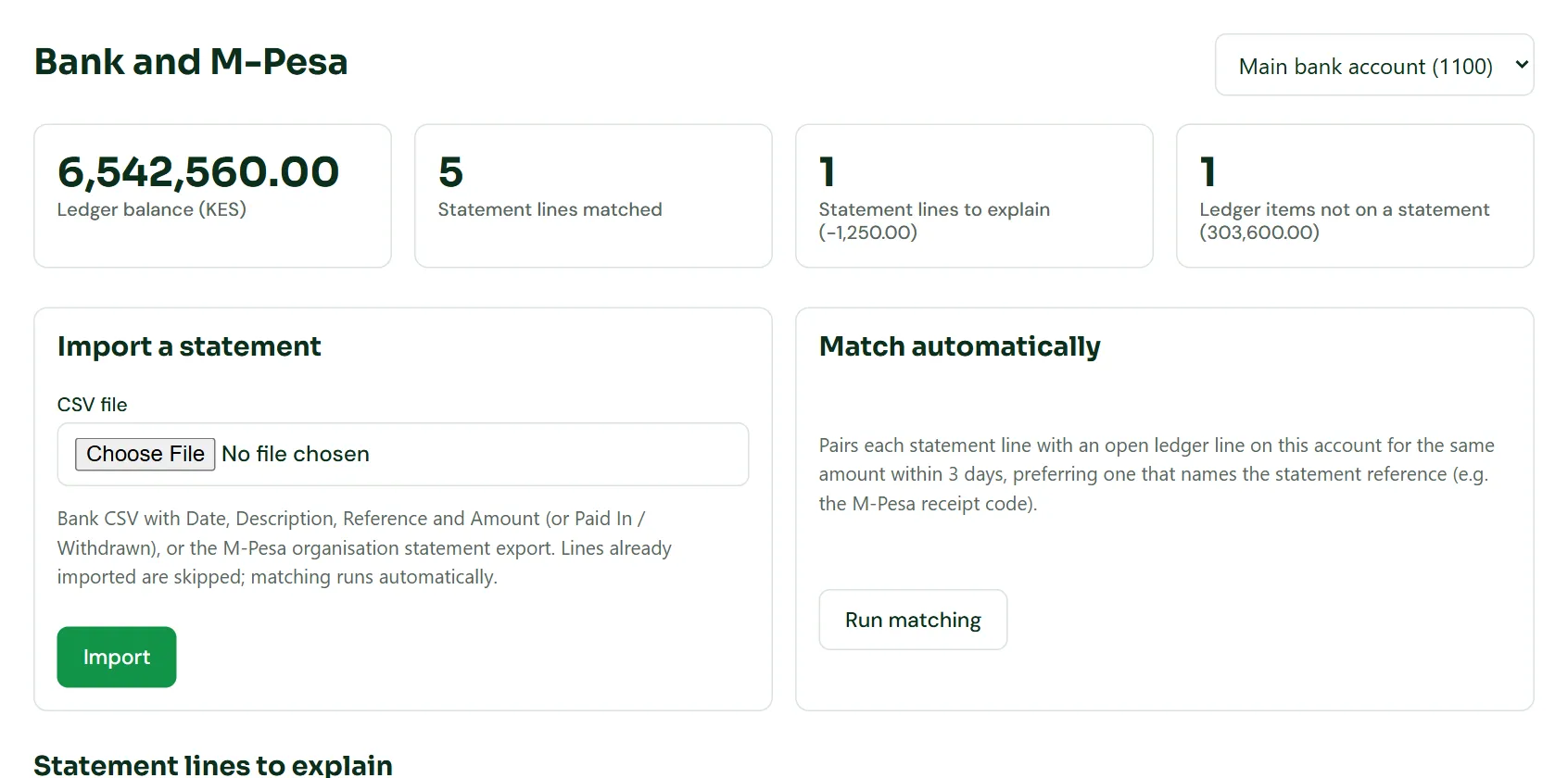
Bank and M-PESA statements that match themselves
Import a bank CSV or an M-PESA organisation statement. Lines already imported are skipped, and the rest are paired with your ledger.
- Matches on amount within 3 days, preferring the reference
- What is left to explain is shown, such as a bank charge
- Supplier bills matched to goods received, and supplier payments need a second approver
Books that balance, because the farm work posts itself
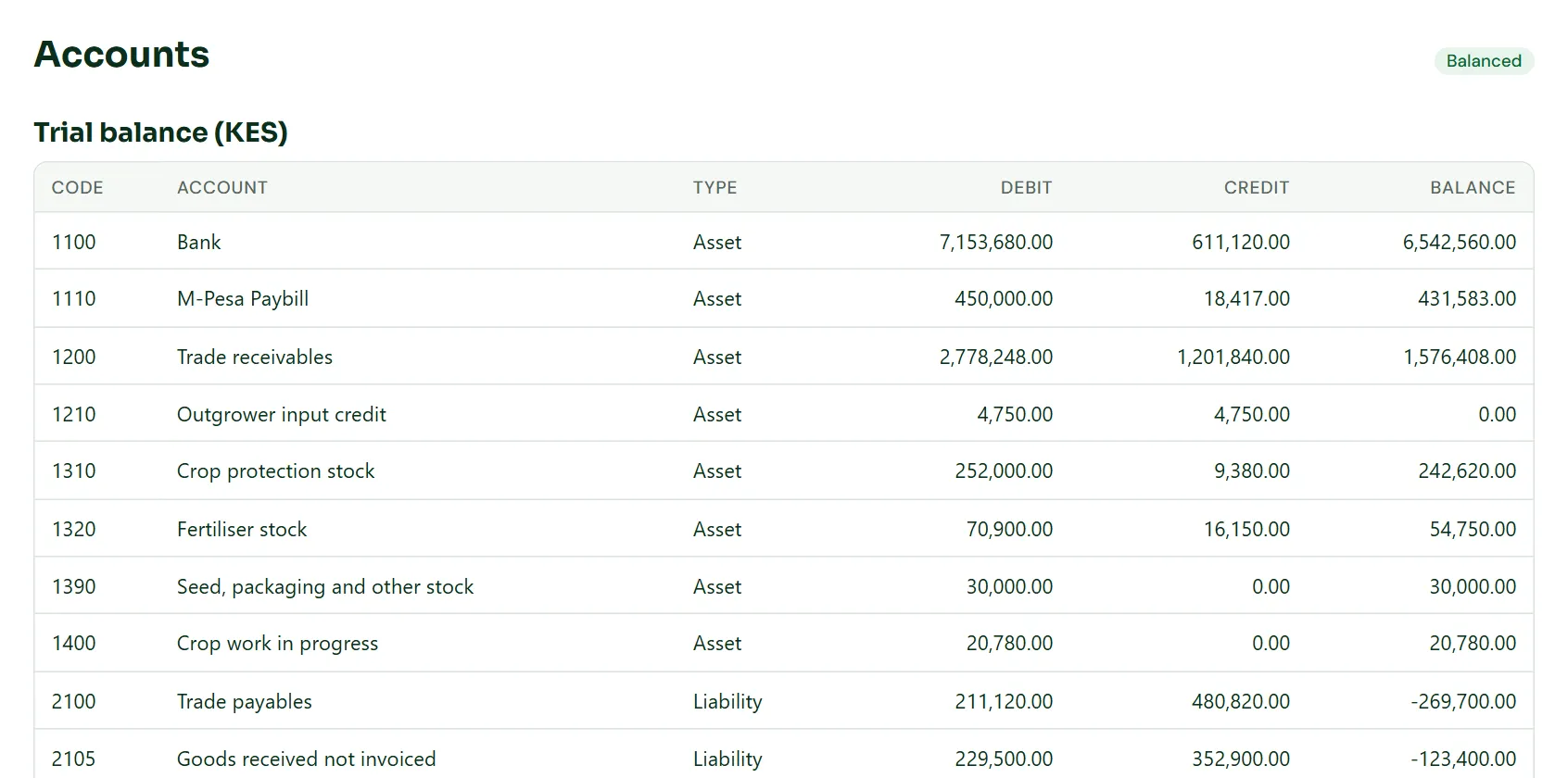
A Kenyan chart of accounts with real double entry. Stock issues cost the planting as work in progress, and entries are reversed, never edited.
- Trial balance and journal list
- Monthly VAT summary, with sales and purchases registers in the iTax VAT3 columns
- Every change is on the audit trail
Who it's for
Built for how horticulture works in Kenya
Flower estates
Greenhouse blocks, scouting rounds, chemical stock and spray records your buyers will ask to see. Invoices in euro.
Exporters with outgrowers
Register farmers, check sprays per plot, weigh at the centre, then pay by M-PESA in approved batches.
Commercial farms
Crop costs by planting, stock by batch, and books that do not need retyping at month-end.
Co-operatives and farmer groups
Member records with consent, deliveries with lot codes, levies by group and a payment run members can follow.
Agro-dealers
Stock by batch and expiry, supplier bills, customer invoices through eTIMS, and input credit you can track.
Trust
Your farm’s data stays yours
Kept apart
One web address and one database per client. A sign-in works at its own workspace and nowhere else.
Two pairs of eyes
Roles decide what each person sees and does. A scout cannot approve a spray, and whoever prepares a payment cannot approve it.
Farmers protected
Consent recorded at registration. National ID and phone encrypted and masked. Withdrawing consent suspends the farmer.
Nothing quietly changed
Every change goes on an audit trail. Accounting entries are reversed, never edited.
Export any time
Download your whole workspace as a ZIP of CSV files that open in Excel.
Leave cleanly
Close the workspace and billing stops. Data is kept for 90 days, then deleted, and you get a deletion certificate.
Compare
Why not the exercise book and a WhatsApp group?
| Feature | Agriware | Exercise book and WhatsApp | General accounting package |
|---|---|---|---|
| Refuses a harvest under PHI | Yes | No | No |
| Checks sprays against PCPB and the market | Yes | No | No |
| Lot code for every delivery | Yes | No | No |
| Farmer payments with a second approver | Yes | No | By hand, or extra cost |
| Crop cost by planting | Yes | No | By hand, or extra cost |
| KRA eTIMS invoices | Yes | No | By hand, or extra cost |
| Bank and M-PESA statements matched | Yes | No | By hand, or extra cost |
A general guide. Accounting packages differ, and many are good at the books; they just do not know what a PHI is. Agriware has no QuickBooks link yet.
FAQ
Agriware questions
Which crops does it work for?
Agriware starts with a Kenyan list of 14 crops and 15 pests, and works for cut flowers (by stems) and vegetables (by kilo). The chemical list in the demo is sample data: your agronomist should confirm PHIs, rates and registrations for your own products.
Does it work without network in the shamba?
The web workspace needs a connection. Agriware Field, an Android app built to work offline and sync when signal returns, is not released yet: it must first finish testing on real devices. Ask us where that stands when you book your demo.
Can it really pay farmers by M-PESA?
Yes, through your own Safaricom contract. You need a Daraja B2C agreement on your organisation’s M-PESA account, which Safaricom sets up with you. Until it is in place you can still run settlements and pay another way.
Is it ready for KRA eTIMS?
Agriware connects to eTIMS through OSCU. You apply to KRA for an OSCU and enter the device serial number in Settings. Until then invoices post as normal and wait as Pending, and they go to KRA once you are connected.
How is this different from Farm to Fork?
Both are from Lightswitch. Farm to Fork traces each pack from plot to pallet and on to the buyer. Agriware runs the farm and the money behind it: agronomy, outgrowers, farmer payments, invoices and the books.
Will it get us a certificate like GLOBALG.A.P.?
No software can do that for you, and Agriware does not manage certificates yet. It does keep the scouting, spray, stock and harvest records an auditor will ask to see, in one place.
What does Agriware not do yet?
These are planned but not built, so please do not buy for them today: export documents and KESWS; packhouse, pallets and cold chain; USSD and SMS to farmers; Bluetooth scales, printers and QR labels; certificates and EUDR plot maps; a QuickBooks link, purchase orders, budgets and payroll.
What happens to our data if we leave?
Export everything at any time as CSV files. When you close the workspace, billing stops at once. The data is kept for 90 days, then deleted, and you get a deletion certificate.
Free demo
Get your Agriware demo access
Send the form and we'll email you the demo link and sign-in straight away. We'll also call you to arrange a guided walk-through, by Zoom, phone or at your premises.
- 0724776933
- WhatsApp us
- hello@lightswitch.co.ke
- 51 Lenana Rd, Block A, Suite A4, Nairobi Kenya
- Mon–Fri 8:00–17:00